
Style
What happens in an aromatherapy massage (and what to ask first)
Oct
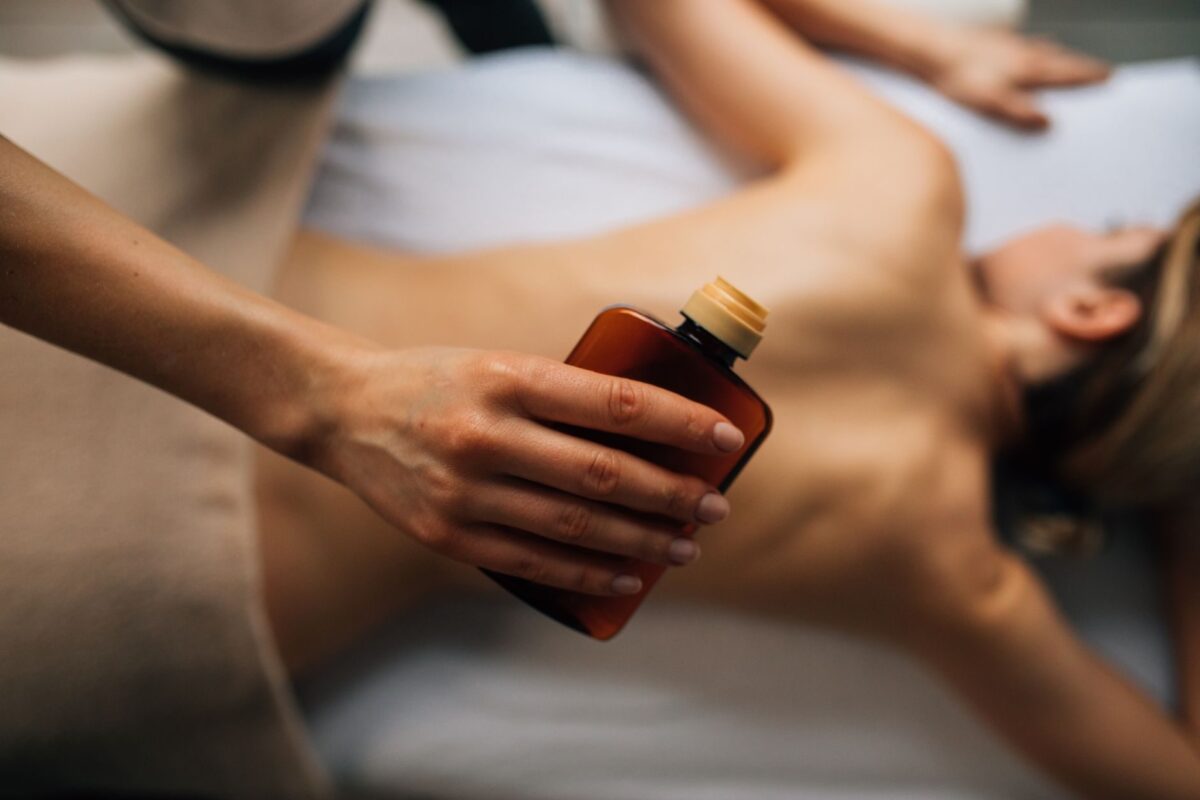
An aromatherapy massage is an ordinary hands-on massage, usually in the Swedish relaxation style, performed with a carrier oil to which a small amount of essential oil has been added. The strokes are not special; the product is. This guide is about the appointment itself: where the practice came from, what a therapist does with the oils, who needs to take care, and the questions worth asking before anyone opens a bottle. For how essential oils behave and how to use them at home, see our separate guide, Aromatherapy for relaxation: what the evidence says.
Where aromatherapy massage comes from
Scented oils have been rubbed into skin in many cultures for millennia, but the word and the modern practice are twentieth-century and largely French. The chemist René-Maurice Gattefossé coined “aromathérapie” as the title of his 1937 book, drawing on some twenty years of work with essential oils in his family’s perfumery business. The army surgeon Jean Valnet extended the medical use of oils in the 1940s and 1950s.
The massage application specifically is credited to Marguerite Maury (1895 to 1968), an Austrian-born biochemist who worked in France, Switzerland and England. She diluted essential oils in vegetable carrier oils and applied them through massage, chose blends for the individual rather than the complaint, and trained therapists in her method until her death; her 1961 book was published in English in 1964 as The Secret of Life and Youth. The salon and spa aromatherapy massage offered today in Europe, North America, Australia and across Asia descends mainly from her approach.
What a session involves
The consultation is longer than for a plain massage because the oil has to be chosen. A good therapist asks about allergies, skin conditions, asthma or breathing problems, epilepsy, pregnancy, medication (including blood thinners) and whether you will be in strong sun later that day. You may be offered two or three diluted blends to smell before one is chosen, and you can ask for an unscented carrier instead. The massage itself is typically 60 minutes, light to moderate in pressure, with long gliding strokes and gentle kneading; vigorous deep work is not the point.
Ask three things before the oil goes on: which essential oils are in the blend, roughly how dilute it is, and whether any ingredient is phototoxic. A therapist who cannot answer should not be mixing blends.
Key techniques
Because the oil increases glide, aromatherapy massage leans on effleurage (long sweeping strokes) and light petrissage (kneading) to spread the product and warm the tissue. Some practitioners add slow holds over the back or feet, and many finish with work on the face or scalp using a lower-strength blend or none. Inhalation is part of the experience: the scent is part of what you are choosing.
Who tends to choose it
People who enjoy scent, who want a gentle rather than remedial treatment, and who like the ritual of choosing a blend. It also suits people who find plain massage slightly clinical. It is a poor fit for anyone with fragrance sensitivity, migraine triggered by smells, or very reactive skin, and for those who simply want firm muscular work; for that, Swedish massage explained or the firmer styles in our comparison guide are better starting points.
Suitability, contraindications and red flags
The hands-on part carries the usual massage cautions. The oil adds its own:
- Allergy and sensitisation. Essential oils can irritate or sensitise skin even when the plant is familiar. A patch test does not guarantee that a product will not cause a reaction; follow the product’s directions and check ingredients, dilution and any light-exposure warnings.
- Phototoxic oils. Cold-pressed bergamot, lemon, lime and grapefruit can cause a burn-like reaction if the skin is then exposed to sun or a tanning bed. Avoid them on exposed skin before daylight.
- Children. Oils high in menthol or 1,8-cineole (peppermint, eucalyptus, some rosemary) should not be applied on or near the face of infants and young children because of reported breathing reactions.
- Epilepsy, asthma and blood thinners. Some oils are traditionally avoided with seizure disorders; strong scents can trigger asthma; wintergreen and birch (methyl salicylate) are usually avoided with anticoagulants. Disclose all three.
- Fire. Oil-soaked towels and sheets can self-heat in a tumble dryer; clinics wash them hot and air-dry. Our candles and oil burners fire-safety guide explains why.
Postpone if you have a fever, infectious illness or broken skin where oil would be applied. A scented massage is also not a way of managing a symptom that has not been looked at; have it assessed first. Stop the session for stinging, a spreading rash, wheeze, headache or nausea from the scent.
Can you learn it at home?
Only the massage part, and only with a plain oil. Choosing, diluting and combining essential oils safely is a separate skill with real pitfalls (undiluted oils, phototoxic blends, oils near a child’s face), and this article deliberately does not give recipes. If you want to try a scented self-massage, read the essential-oil safety guide linked above first, patch-test (which does not guarantee against a reaction), keep the blend weak, use it on a forearm or lower leg, and stay out of the sun afterwards. A plain unscented carrier gives you the same gliding strokes with none of those variables.
Frequently asked questions
Does the scent treat a medical condition? Not in any way that has been reliably shown. Relaxation is a reasonable expectation; a cure for an illness is not.
Are “natural” oils automatically safe on skin? No. Natural does not mean inert; some of the most irritating and phototoxic substances in a therapist’s kit are plant-derived.
Will I smell of it afterwards? Yes, for a while afterwards. If you are heading somewhere scent-sensitive (a hospital, a workplace with a fragrance policy), book for later in the day.
Can I bring my own oil? Many therapists will accept a sealed, labelled product, but they may decline anything whose ingredients they cannot verify.
Educational information, not medical advice. For actual pain, persistent or unexplained symptoms, injury, or anything that worries you, seek assessment from a qualified health professional before trying or receiving massage. Stop any technique that causes pain.
Sources
- EBSCO Research Starters, “René-Maurice Gattefossé” (biography; 1937 Aromathérapie)
- McGill University Office for Science and Society (Canada), “Aromatherapy”, history note on Gattefossé and Valnet
- International Federation of Aromatherapists, “Essential oils: the autumn years” (Marguerite Maury biography, 1895 to 1968)
- Salvatore Battaglia (Australia), “Marguerite Maury’s guide to aromatherapy: the secret of life and youth” (1961 French edition, 1964 English translation)
- University of Minnesota, Earl E. Bakken Center for Spirituality and Healing, “Are essential oils safe?” (phototoxic citrus oils, dilution)
- Tisserand Institute, “Peppermint and eucalyptus for children” (inhalation and facial-application cautions); Tisserand & Young, Essential Oil Safety, 2nd edition, 2014
- National Center for Complementary and Integrative Health (USA), “Massage therapy: what you need to know”, 2019

 English
 French