
Style
Chair massage: the short, clothed, seated format and who it suits
Oct
Chair massage is not a style of massage but a way of delivering one. You sit forward in a purpose-built chair, fully clothed, with your face in a padded cradle and your arms on a rest, and a therapist works on your back, shoulders, neck, arms and hands for anywhere between ten and thirty minutes. Because it needs no oil, no undressing and no private room, it turns up in offices, airports, conferences, shopping centres and sports events worldwide. This guide covers how the format came about, what to expect, and who should ask for an ordinary upright chair instead.
Origins: seated massage before and after the chair
Massage given to a seated person is old; Japanese woodblock prints show bathers being worked on while sitting on low stools, and barbers in India have long finished a haircut with seated head, neck and shoulder work. The modern format, however, has a clear starting point. David Palmer, who ran the Amma Institute of Traditional Japanese Massage in San Francisco, began experimenting with seated “on-site” massage for workplaces in the early 1980s, partly to give massage graduates a clothed, public, stigma-free way to earn a living. Working with the cabinet-maker Serge Bouyssou, he designed a portable chair with a face cradle, chest pad, arm rest and knee pads; it was manufactured by Living Earth Crafts and launched in 1986 as the High Touch Massage Chair, demonstrated that year at an American Massage Therapy Association schools meeting in Seattle. Palmer then taught the format at massage schools internationally (he described running 24 seminars in the following 18 months), and workplace “on-site” programmes spread from there.
What a session involves
The therapist adjusts the chair first: seat height, chest pad angle, face-cradle height and arm-rest position, so that you can breathe freely with your neck in a neutral line and no weight on your knees that you cannot comfortably bear. You will be asked a few quick health questions even in a fifteen-minute slot; expect to be asked about neck or back problems, recent surgery, pregnancy, eye conditions and whether any area should be left alone.
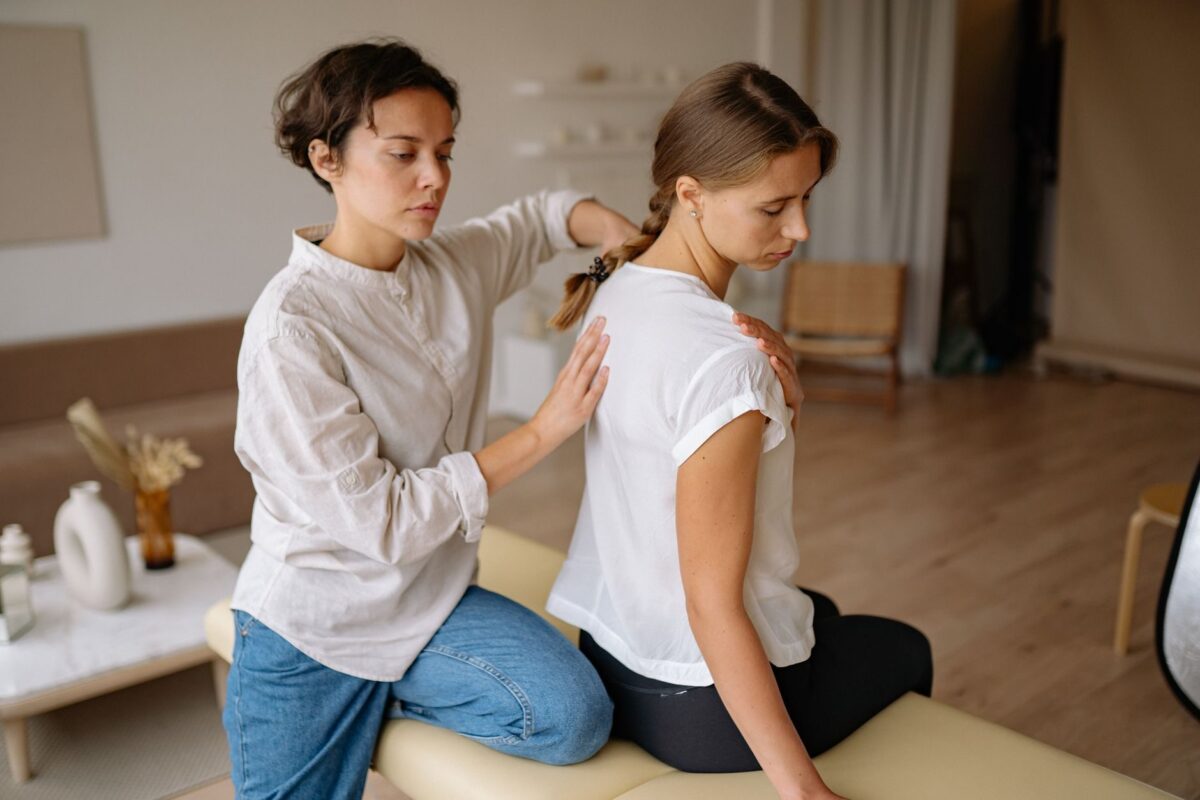
The work is typically through clothing without oil: compression along the muscles either side of the spine, kneading of the shoulders, squeezing down the arms, thumb work on the hands, and sometimes gentle neck strokes and a scalp finish. Some therapists use percussion (light tapping) over the upper back. A good session ends with a moment to sit up slowly before standing.
Key techniques
Chair work borrows from amma and shiatsu (compression and thumb pressure along the back), from Swedish massage (kneading of shoulders and forearms) and from sports massage (compression and broad pressure). What it should never include is direct downward pressure on the spinal bones, forceful neck movements or “cracking”, or any technique you have not agreed to.
Who tends to choose chair massage
People with little time, people who prefer to stay dressed, employees in workplace wellbeing schemes, travellers between flights, and anyone trying massage for the first time who wants a low-commitment introduction. It is also a sensible alternative for people who cannot lie face-down. If your main complaint is lower-body tension, the format will not reach it; a table session or the self-care ideas in relaxation techniques you can practise at work may serve you better.
Suitability, contraindications and red flags
The seated position avoids some of the problems of lying prone, but it introduces its own.
- Face cradle and eyes. Resting face-down puts gentle pressure around the eye sockets and, with the head below the heart, raises pressure inside the eye slightly. Tell the therapist if you have glaucoma, recent eye surgery or a retinal condition; they can position you upright with the head supported differently or skip the cradle.
- Pregnancy. The chest pad presses against the front of the body as you lean forward, which is uncomfortable and inappropriate in later pregnancy; a sideways-seated position on an ordinary chair, or a table session with a trained prenatal therapist, is the usual substitute.
- Knees, hips and back. The forward-leaning posture loads the knees and flexes the spine; recent knee, hip or back surgery, severe arthritis or a disc problem under treatment are reasons to ask for an upright chair.
- Dizziness and blood pressure. Standing quickly after leaning forward can make people light-headed; sit up slowly.
- General cautions are the same as any massage: bleeding disorders, anticoagulants, osteoporosis, cancer treatment, fever, infectious illness or skin infection over the area.
Stop the session if breathing feels restricted, if you feel faint, or if any pressure produces sharp, electric or spreading sensations into an arm.
Learning from the format at home
You cannot reproduce a therapist’s chair work on yourself, and asking an untrained friend to lean on your neck while you slump forward is a bad idea. What you can borrow is the principle of short, clothed, seated self-care at a desk:
- Sit tall in a stable chair with both feet flat.
- Squeeze the top of the opposite shoulder between fingers and heel of the hand, a few slow squeezes each side, then knead down the upper arm and forearm.
- Press the thumb pad into the palm of the other hand in slow circles for a short while.
- Finish with a few gentle shoulder rolls.
Keep pressure moderate, never press into the front or sides of the neck, and stop at the first sign of discomfort. Our guides to desk stretches and micro-breaks and upper-back self-massage without assistance go further, and the principles of safe home practice are set out in learning massage safely.
Frequently asked questions
How long does a chair massage last?
Usually ten to twenty minutes in workplaces and events, up to thirty in a clinic; it is a focused upper-body session, not a full-body treatment.
Do I have to take anything off?
No; you stay clothed, though a thick coat, jewellery and anything in back pockets should come off.
Is it suitable if I am pregnant?
Not in the standard forward-leaning position; ask for a seated side-on or upright alternative and tell the therapist how many weeks you are.
Will it sort out my desk-related back pain?
It may ease tension for a while, but persistent pain needs assessment, and a quick chair session is comfort rather than treatment and never a reason to put that assessment off.
Educational information, not medical advice. For actual pain, persistent or unexplained symptoms, injury, or anything that worries you, seek assessment from a qualified health professional before trying or receiving massage. Stop any technique that causes pain.
Sources
- MASSAGE Magazine (USA), history feature on the High Touch Massage Chair (David Palmer, Serge Bouyssou, Living Earth Crafts, 1986), 2002 issue 97
- Associated Bodywork & Massage Professionals (USA), “Chair massage” modality article (David Palmer, on-site massage, Japanese seated-massage precedents)
- Institute for Integrative Healthcare Studies (USA), “Why all massage therapists should know chair massage” (Palmer’s early-1980s on-site work)
- Philippine Academy of Ophthalmology journal, study of intraocular pressure during prone face-down massage
- Anesthesia Patient Safety Foundation (USA), “The underappreciated dangers of the prone position” (eye pressure and glaucoma)
- National Center for Complementary and Integrative Health (USA), “Massage therapy: what you need to know”, 2019

 English
 French