
Uncategorized
Forearm Massage for Desk Workers
Sep
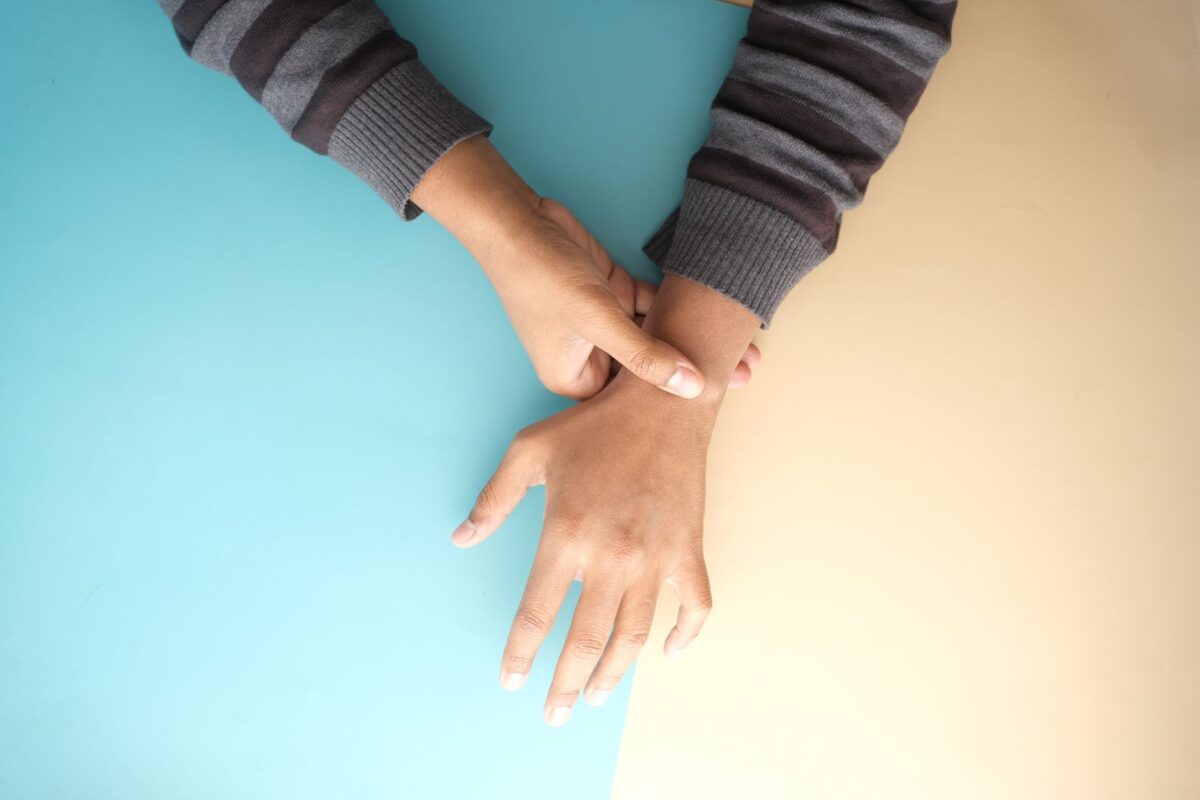
Typing, mouse work and phone scrolling all run through the muscles of the forearm. By the middle of the afternoon they can feel worked in a way that is easy to ignore until you stop. A two-minute forearm massage is a good reason to take your hands off the keyboard, and it can feel very pleasant. This guide sets out a simple routine, and is equally clear about what massage cannot do: it does not fix a poor workstation, and it is not the answer to persistent tingling, weakness or pain.
A two-minute routine
Do this seated at your desk. About a minute per arm.
- Support the arm. Rest one forearm on the desk or a cushion, palm up, with the hand relaxed.
- Broad strokes (20 seconds). With the palm of your other hand, make slow strokes from just above the wrist towards the elbow, staying on the fleshy part of the forearm.
- Small circles (20 seconds). Use the pad of your thumb or your flat fingers to make slow circles along the muscle. Mild pressure only. If a spot produces tingling, move off it.
- Turn over (15 seconds). Turn the forearm palm down and repeat the strokes along the top, with lighter pressure, as there is less padding on this side.
- Finish (5 seconds). Slowly open your hand wide and make a soft fist, five times.
Then change arms. For a fuller break, add the routine from our five-minute hand and palm massage.
Where not to press
- The wrist and the elbow. Keep your pressure on the muscle between the two joints.
- Any point that produces tingling, numbness or an electric sensation. That is a signal to move away, not to press harder.
- Bone. Stay on the fleshy part of the forearm.
Massage does not fix the set-up
If your forearms feel worked every day, look at the pattern of work. For people who work at screens, the Health and Safety Executive says the law requires employers to plan work so there are breaks or changes of activity. Its advice is to take short breaks often, giving the example that five to ten minutes every hour is better than twenty minutes every two hours, and it says breaks should allow you to get up and move around, or at least stretch and change posture. It also notes that in most jobs it is possible to stop screen work to do other tasks, such as going to meetings or making phone calls.
Practical changes that help make breaks happen:
- tie a short break to regular events, such as finishing a call or sending a long email;
- alternate between mouse-heavy and keyboard-heavy tasks where you can;
- stand up for phone calls;
- if you have concerns about your workstation, ask your employer about a workstation assessment.
See desk stretches and micro-breaks and relaxation techniques you can practise at work for more.
When it is more than tired forearms
The NHS describes repetitive strain injury as pain caused by repeated movement of part of the body, and lists the forearms and wrists among the areas affected. Symptoms usually start gradually and can include pain that may feel like burning, aching or throbbing, stiffness and weakness, tingling, pins and needles or numbness, muscle cramps and swelling. It gives typing as one example of a repetitive activity that can be involved, while noting that repetitive work does not always cause RSI.
The NHS self-care advice for RSI is to keep active, use painkillers or a cold pack wrapped in a towel for up to 20 minutes every two to three hours, and speak to your employer about ways they can help you continue working. It advises against resting the affected area for more than a few days. It says to see a GP if symptoms are not going away or are getting worse, and notes that a physiotherapist may use massage alongside exercises as part of treatment. That is a different thing from self-massage at your desk.
Tingling and numbness in the hand and fingers, a weak thumb or difficulty gripping, often worse at night, are listed by the NHS as symptoms of carpal tunnel syndrome, which is pressure on a nerve in the wrist. Do not try to massage those symptoms away. See a GP if they are getting worse or not going away.
Safety
Stop straight away if you feel sharp, electric or worsening pain, tingling, dizziness, numbness, weakness, unusual swelling, breathlessness, or you simply feel unwell.
Do not massage the forearm over broken, infected or inflamed skin, bruising, unexplained swelling, a suspected blood clot, a recent injury or surgical site, a numb area, or anywhere a clinician has told you to avoid.
Get individual advice first if you are pregnant, take anticoagulant medicine, or have a bleeding disorder, reduced sensation, fragile bones, a diagnosed vascular condition, an implanted medical device, recent surgery, or treatment that may affect whether massage is suitable for you.
The US National Center for Complementary and Integrative Health says the risk of harmful effects from massage therapy appears to be low, but that there have been rare reports of serious side effects such as a blood clot, nerve injury or bone fracture, some involving vigorous types of massage or people at increased risk of injury, such as elderly people. That is the reason every routine here uses mild pressure. It also advises against using massage to postpone seeing a health care provider about a medical problem.
The bottom line
Support the arm, use broad strokes and slow circles on the fleshy part of the forearm, stay away from the wrist and elbow, and stop at any tingling. Use it as a reason to take a proper break, and make those breaks short and frequent. If pain, tingling, numbness or weakness persists, that is a matter for your GP and your employer, not for more massage.
Sources
- NHS, “Repetitive strain injury (RSI)”
- NHS, “Carpal tunnel syndrome”
- Health and Safety Executive, “Working safely with display screen equipment: Work routine and breaks”
- National Center for Complementary and Integrative Health, “Massage Therapy: What You Need To Know”
Last reviewed: 19 September 2026. This article is general information about everyday relaxation and is not medical advice.

 English
 French