
Uncategorized
Massage-Gun Attachments Explained
Sep
Most massage guns arrive with a bag of interchangeable heads and very little explanation. The shapes look technical, and the marketing often attaches a specific benefit to each one. In practice the differences are simpler: each head changes how much area the force is spread over, and therefore how intense it feels. This guide explains the common shapes, which to start with, and which deserve extra care.
First, what the research does not tell us
There is no good evidence that one attachment shape produces better results than another. A 2023 systematic review of massage-gun studies found benefits for short-term flexibility and some recovery measures, but the included studies did not compare head shapes, and ten of the eleven carried a moderate risk of bias. So treat attachment choice as a matter of comfort and control, not of proven effect. Anything more specific than that in a product listing is marketing.
The principle: surface area sets intensity
The motor delivers the same stroke whichever head is fitted. A large, soft head spreads that force over a wide area, so it feels gentle. A small, hard head concentrates the same force into a point, so it feels much stronger. That single idea explains almost everything below.
The common heads
Round ball
The general-purpose head, usually foam or rubber. It suits large, fleshy muscles such as the thighs, glutes and calves. If your device has a larger and a smaller ball, the larger one is the gentler of the two. This is the right head to start with.
Soft or cushioned head
Some kits include an air-filled or gel-padded head. It is the gentlest option and a sensible choice for anyone new to the device, for smaller muscles, and for areas that feel tender. Not every kit has one.
Flat head
A flat disc gives a broad, even contact. It works well on dense, flat muscle areas such as the upper back muscles either side of the shoulder blades, the chest muscle and the thighs. It feels firmer than a foam ball because it does not compress, so keep the speed low.
Bullet or cone
The small pointed head concentrates force into a tiny area and is the most intense attachment in the box. It is the one most likely to cause bruising. If you use it at all, keep to the lowest speed, a light touch, a few seconds at a time, and only on thick muscle well away from bone, joints, nerves and the areas listed in where you should never use a massage gun. Many people never need it.
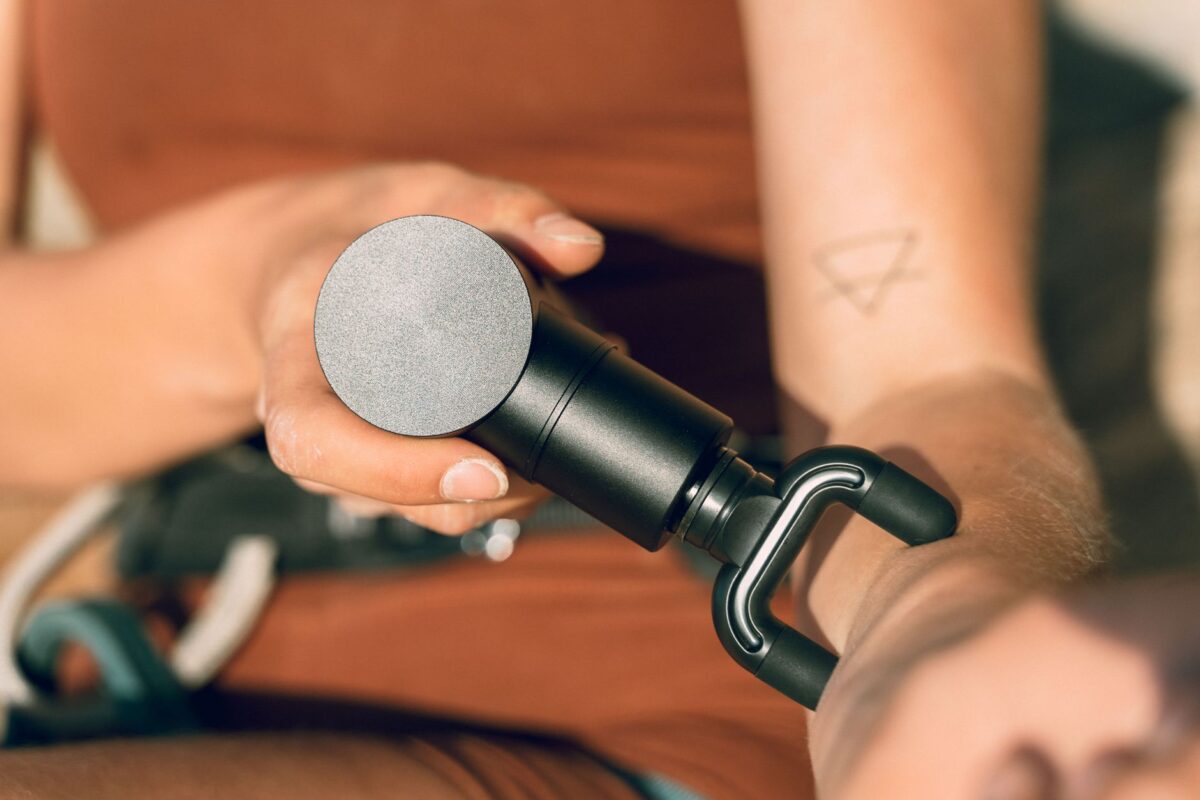
Fork or U-shaped head
The two-pronged head is often marketed for running either side of the spine or the Achilles tendon. We advise against both. Self-massage should not be directed at the spine, and a fork head leaves very little margin for error beside it. A safer use is on a large muscle, such as the calf, with the prongs resting on muscle tissue only. If in doubt, leave this one in the bag.
Thumb, wedge and shovel heads
Thumb-shaped heads imitate a therapist’s thumb and behave like a slightly broader bullet, so the same caution applies. Wedge or shovel heads are designed for a scraping motion along a muscle. Both are firmer than a ball. Neither is necessary for everyday relaxation use.
Choosing a head: a simple order
- Begin with the softest, largest head on the lowest speed.
- Move to the flat head only if the ball feels too vague on a broad area and the pressure stays comfortable.
- Treat the bullet, thumb and fork heads as optional extras that need more care, not as upgrades.
Whichever head you fit, the technique in how to use a massage gun more safely still applies: let the device rest under its own weight, keep it moving, and stay on muscle.
Materials and cleaning
Foam heads are comfortable but absorb sweat and oils, so they need wiping after each use and replacing when they start to break down. Hard plastic and silicone heads are easier to clean. Cleaning methods differ between models, so follow the instructions supplied with your device. Avoid sharing heads between people without cleaning them.
Safety applies to every head
Stop straight away if you feel sharp, electric or worsening pain, dizziness, numbness, weakness, unusual swelling, breathlessness, or you simply feel unwell. Do not use a massage gun on broken, infected, inflamed or numb skin, on unexplained swelling, on a suspected blood clot, on a recent injury or surgical site, on prominent bone, joints or the spine, or on any area a clinician has told you to avoid.
Get individual advice first if you are pregnant, take anticoagulant medicine, or have a bleeding disorder, reduced sensation, fragile bones, a diagnosed vascular condition, an implanted medical device, recent surgery, or treatment that may affect whether massage is suitable for you.
The bottom line
Attachments change how concentrated the force is, not what the device can do. A soft round head on a low setting covers most needs. The pointed and forked heads carry more risk for no proven extra benefit, so use them sparingly or not at all. Pressure, placement and time matter far more than shape.
Sources
- Ferreira et al., “The Effects of Massage Guns on Performance and Recovery: A Systematic Review,” Journal of Functional Morphology and Kinesiology (2023)
- National Center for Complementary and Integrative Health, “Massage Therapy: What You Need To Know”
Last reviewed: 19 September 2026. This article is general information about everyday relaxation and is not medical advice.

 English
 French