
Style
What a professional foot massage involves (and how it differs from reflexology)
Oct
A foot massage works the feet for their own sake: the small muscles of the sole, the thick band of tissue along the arch, the ankle and the toes. It is offered as a stand-alone treatment, as the closing part of a full-body session, and in street-front foot-massage shops across East and Southeast Asia. It is not the same thing as reflexology, which uses the feet as a map of the body, although the two are often sold side by side. This guide covers what a professional session involves, which structures are being touched, who needs to speak up first, and how it compares with the self-care routines we already publish.
Origins: a universal practice without a single birthplace
Rubbing tired feet is so widespread that it has no founder and no home country. The oldest image often cited is a wall relief in the tomb of Ankhmahor at Saqqara, Egypt (Sixth Dynasty, roughly 2300 BCE), showing attendants working on the hands and feet of seated men; Egyptologists have read it variously as massage, manicure and pedicure, or a surgical procedure, and the reflexology interpretation promoted by some practitioners is one reading among several rather than an established fact. Foot massage has long been part of Thai, Chinese and Indian bodywork, of Japanese bath-house culture, and of European spa tradition. The modern reflexology system is separate and recent: the American physician William Fitzgerald published “zone therapy” in 1917, and the physiotherapist Eunice Ingham mapped it onto the feet in the 1930s, publishing Stories the Feet Can Tell in 1938. A foot massage borrows none of that framework.
What a session involves
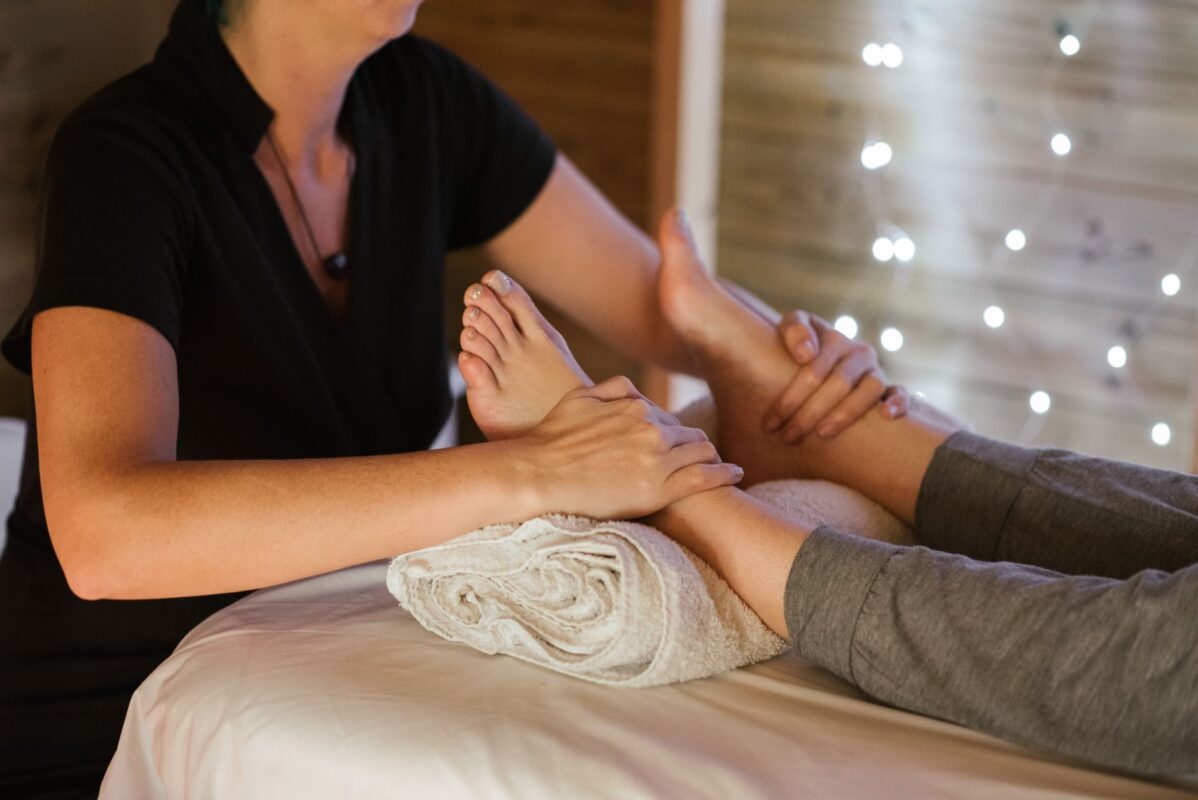
You sit in a reclining chair or lie on a table with footwear off and the lower legs exposed. Many Asian foot-massage shops begin with a warm foot soak. The therapist asks about diabetes, circulation problems, numbness, recent sprains, skin conditions and whether any area should be avoided, then works each foot for ten to thirty minutes: broad strokes over the top and sole, thumb pressure along the arch, kneading of the heel pad, gentle movement of each toe, circling of the ankle and usually some work up the calf. Lotion or oil is common; firm thumb or knuckle pressure is common in Chinese-style shops and can be strong, so state your preference early.
Key techniques and what is under the hand
- Effleurage: long strokes from toes to ankle on top and underneath.
- Thumb walking along the arch, where the plantar fascia (a thick connective-tissue band) and the first layer of sole muscles lie: abductor hallucis along the inner edge and flexor digitorum brevis down the centre.
- Kneading of the heel pad and the ball of the foot.
- Toe traction and circling, gentle and never forced.
- Ankle mobilisation and calf strokes to finish.
Deeper layers of the sole, and the tendons that run from the calf under the foot, are not something to dig for; a tender spot in the arch is as likely to be fascia or a nerve as a “knot”. Pressing hard into the heel bone, or repeatedly into one painful point, is a reason to ask the therapist to ease off.
Who tends to choose it
People who stand or walk all day, runners and hikers, travellers after long flights, people who dislike undressing for a full-body session, and those who find foot contact especially relaxing. It is also the usual form of massage offered to people who cannot lie flat.
Suitability, contraindications and red flags
The feet carry some specific risks:
- Diabetes and reduced sensation. Numbness makes it impossible to judge pressure or water temperature, and minor skin damage heals poorly; tell the therapist, ask for light pressure, and have any foot ulcer or wound assessed rather than massaged.
- Ulcers, broken skin, athlete’s foot, verrucas or nail infection. Postpone; these are both a risk to you and contagious to the next client.
- Gout flare, recent sprain or fracture. Wait until cleared.
- Swelling in one calf or foot, especially with warmth, redness or tenderness, is a reason to seek urgent medical assessment rather than a massage; a blood clot is one of several possible causes that need ruling out first.
- Pregnancy. Foot massage is generally fine with light pressure, but tell the therapist and avoid firm ankle pressure if they prefer to be cautious.
- Peripheral arterial disease, severe varicose veins, recent foot surgery. Seek advice first.
Stop for sharp pain, tingling or numbness spreading into the toes, or any pain in the calf during the session. Do not let a foot massage stand in for getting persistent heel, arch or calf pain assessed.
Learning at home
We already publish a complete routine, foot self-massage: hands, ball and foot-spa options, so this guide will not repeat it. The short version: sit securely, support the foot without straining your hip, check the skin, use light strokes then gentle thumb circles over the fleshy arch, and ease off rather than press harder at a tender spot. If you want to add warmth, how to use a foot spa covers temperature and hygiene, and calf self-massage techniques extends the routine upward.
Frequently asked questions
Is foot massage the same as reflexology?
No; reflexology applies pressure to points said to correspond to organs, a traditional map that is not an anatomical connection, whereas foot massage treats the foot itself.
Why does the arch hurt when pressed?
The arch contains a thick fascial band, nerves and small muscles that are tender in many healthy people; tenderness is not a diagnosis and persistent heel or arch pain needs assessment.
Can I have a foot massage if I have diabetes?
Often yes with light pressure and intact skin, but mention it first, and never let anyone massage over an ulcer or numb, damaged skin.
Is a foot spa a substitute?
It is a different comfort activity; warm water does not replace hands, and people with reduced sensation need to check the temperature with a thermometer rather than a toe.
Educational information, not medical advice. For actual pain, persistent or unexplained symptoms, injury, or anything that worries you, seek assessment from a qualified health professional before trying or receiving massage. Stop any technique that causes pain.
Sources
- Queensland University of Technology (Australia), podiatry anatomy resource, “Intrinsic muscles of the foot” (four layers; abductor hallucis and flexor digitorum brevis in the first layer)
- Journal of Ultrasound in Medicine, “Ultrasound of the plantar foot: a guide for the assessment of plantar intrinsic muscles”, 2023
- Archaeology magazine (Archaeological Institute of America), “Wellness: Egypt, foot massage”, September–October 2021 (tomb of Ankhmahor and competing interpretations)
- Badawy, A., The Tomb of Nyhetep-Ptah at Giza and the Tomb of Ankhmahor at Saqqara, 1978 (standard reference for the reliefs)
- Discover magazine (USA), “Reflexology and other stories” (Fitzgerald 1917, Ingham 1938)
- National Center for Complementary and Integrative Health (USA), “Massage therapy: what you need to know”, 2019

 English
 French